What Is LLM Visibility? Definition, Measurement, and 2026 Benchmarks
Read the postDateApr 14, 2026
CategoryResearch

If you have a strong SEO program, you already have a head start on AI visibility. Schema markup, fast page speeds, structured content, and authoritative writing all help. The overlap is real. But it is partial. Research consistently shows that traditional SEO metrics like domain authority and backlink profiles have near-zero or negative correlation with how often AI models recommend brands. Winning in AI search requires strategies that go beyond what SEO covers. And those strategies start with understanding how AI models actually perceive you.
TL;DR
Good SEO gives you a head start on AI visibility, but domain authority and backlinks show near-zero correlation with AI recommendations. Off-site brand mentions, platform-specific tactics, and content freshness matter far more. Build GEO as a layer on top of SEO, not a replacement.
The foundation of a good GEO strategy is, in many cases, good SEO. Several of the highest-evidence GEO tactics are already staples of mature SEO programs. The foundational GEO paper (Aggarwal et al., KDD 2024) tested nine optimization methods across 10,000 queries. Adding statistics to content delivered a 30-40% visibility improvement. Including source citations showed similar gains. Both of these are already best practices in strong SEO content programs.
Schema markup provides structured signals that both Google and AI models can parse. Page speed below 2 seconds improves Core Web Vitals and AI citation rates. Clear, structured answers in what GEO researchers call "answer capsule" format help AI models extract and cite your content. Expert quotes and authoritative sourcing improve both E-E-A-T signals for Google and citation probability for LLMs.
If your SEO team is already doing these things well, you have a genuine advantage. The research confirms it.
| Tactic | SEO Benefit | GEO Benefit | Evidence Strength |
|---|---|---|---|
| Statistics in content | Credibility signals | +30-40% AI visibility | Strong (Aggarwal et al. 2024) |
| Schema markup | Rich snippets | Structured data parsing | Strong |
| Page speed (<2s) | Core Web Vitals | Citation preference | Strong |
| Expert quotes | E-E-A-T signals | +citation rate | Strong |
| Structured headings | Crawlability | Answer extraction | Moderate |
| Comparison content | Featured snippets | Model synthesis | Moderate |
The problem is what most SEO programs are probably not doing.
A SearchAtlas study of 21,767 domains measured the correlation between traditional SEO metrics and AI visibility across major platforms. The results were definitive.
| Platform | Domain Authority vs. AI Visibility (r) | Interpretation |
|---|---|---|
| ChatGPT | -0.12 | Slightly negative |
| Perplexity | -0.18 | Slightly negative |
| Gemini | -0.09 | Slightly negative |
These are not weak positive correlations. They are slightly negative. A high domain authority score does not predict AI recommendations.
An Ahrefs study of 75,000 brands confirmed the disconnect. The strongest predictor of AI recommendation is web mention frequency, with a correlation of 0.664. Backlink profiles, the metric traditional SEO was built on, showed a correlation of just 0.218.
Some long-standing SEO tactics actively hurt AI visibility. The foundational GEO paper found that keyword stuffing performed 10% worse than baseline. FAQ schema markup, widely recommended for traditional SEO, showed a negative impact on AI citations: 3.6 citations per query versus 4.2 for pages without it.
The SEO playbook and the GEO playbook share pages. They are not the same document. Treating them as one leaves significant gaps in your AI visibility strategy.
ARGEO, a GEO consulting firm, launched with zero backlinks, zero Google indexing, and zero domain authority. They were competing for brand recognition against an established Norwegian company with the same name that had years of market presence and a strong backlink profile. By every traditional SEO metric, ARGEO should have been invisible.
Within two months, two companies independently discovered ARGEO through Google Gemini. No paid ads, no link building campaigns, no SEO outreach. As founder Faruk Tugtekin documented, they "didn't game anything" and "didn't manufacture" the results. The leads came from LLM reasoning alone.
The reason it worked comes down to a fundamental difference in how these systems evaluate authority. Google evaluates external signals: links, engagement metrics, domain age. LLMs evaluate internal signals: conceptual clarity, terminology consistency, and how well content aligns with their knowledge graphs. ARGEO focused on entity clarity over keyword density, maintained consistent terminology across all platforms, and built structured knowledge frameworks rather than optimizing for traditional ranking factors.
ARGEO had those internal signals in place from day one. The SEO signals were absent entirely, and it did not matter. This is what the correlation data looks like in practice: a brand that would rank nowhere on Google, surfaced by AI as a relevant recommendation because the content matched what LLMs look for.
GEO introduces an entire category of optimization that traditional SEO programs rarely touch: off-site presence engineering and platform-specific content strategy.
Off-site brand mentions are the single strongest controllable lever for AI visibility, with a 0.664 correlation (Ahrefs, 2025). This is different from backlinks. A backlink is a hyperlink from one page to another. A brand mention is any reference to your company, product, or founder across the web, whether or not it links to you. AI models synthesize mentions from Reddit threads, YouTube video descriptions, review sites, Wikipedia articles, and press coverage. The link itself is irrelevant to an LLM. The mention is what matters.
YouTube presence alone accounts for 29.5% of all sources cited by AI platforms, making it the single most-cited domain across AI engines (correlation: 0.737). Reddit is the second most important source, especially for Perplexity, where it appears in 46.7% of citations. Neither channel typically falls under an SEO team's mandate.
Content freshness operates on a different cadence for GEO. Research shows that updating content within a 90-day window increases AI citations by 67%. SEO content calendars often run on longer cycles, refreshing cornerstone pages annually or semi-annually. AI models penalize stale content more aggressively than Google does.
None of these priorities appear in a typical SEO audit. They require separate strategy, separate measurement, and often separate teams.
One of the most consequential findings from GEO research is that AI platforms do not share a unified ranking system. Only 11% of domains cited by ChatGPT are also cited by Perplexity. A brand that dominates one platform can be invisible on another.
| AI Platform | Top Cited Source | Key Citation Signal |
|---|---|---|
| ChatGPT | Wikipedia (47.9% of top-10) | Bing top-10 alignment (87% overlap) |
| Perplexity | Reddit (46.7% of citations) | Real-time web search, community discussion |
| Google AI Overviews | Reddit (21%), YouTube (18.8%) | Organic top-10 results (93.67% sourced from) |
| Claude | Traditional databases (68%) | Awards, longevity, established reputation |
| Gemini | Authoritative lists (49%) | Google ecosystem authority, local reviews (38%) |
Research from CMU (Wu et al., 2025) introduced AutoGEO, an automated optimization framework that achieved a 35.99% average improvement in AI visibility. Their key finding: engine-specific optimization rules consistently outperform generic strategies. What works for ChatGPT does not necessarily work for Perplexity.
For SEO teams, this is unfamiliar territory. Google SEO is one channel with one ranking system. GEO spans six or more channels, each with different citation behaviors, different source preferences, and different content formats that trigger recommendations. A single optimization strategy cannot cover the landscape.
Here is where the gap between SEO and GEO becomes most consequential. In SEO, you can run a keyword gap analysis, check your rankings, and build a content plan. The inputs are concrete: search volume, keyword difficulty, current position. In GEO, the inputs are different. You need to understand how AI models perceive your brand relative to competitors across dimensions that matter to buyers.
Two brands can have identical AI visibility scores and need completely different GEO strategies. One might be perceived as innovative and affordable, needing more off-site mentions to break through. Another might be perceived as trusted and established, needing content that associates it more strongly with a specific product category. A third might have perfect sentiment when mentioned, yet AI almost never mentions it because it lacks the category association to trigger recommendations.
The Harvard Business Review's "Share of Model" framework (June 2025) argues that brands need to understand the internal representations LLMs build about them. Without that understanding, GEO work is directionless. You end up applying generic tactics instead of the specific interventions your brand actually needs.
This is the core problem: visibility tools tell you the score, but they do not tell you the shape of the gap. You need perception data to design the right strategy.
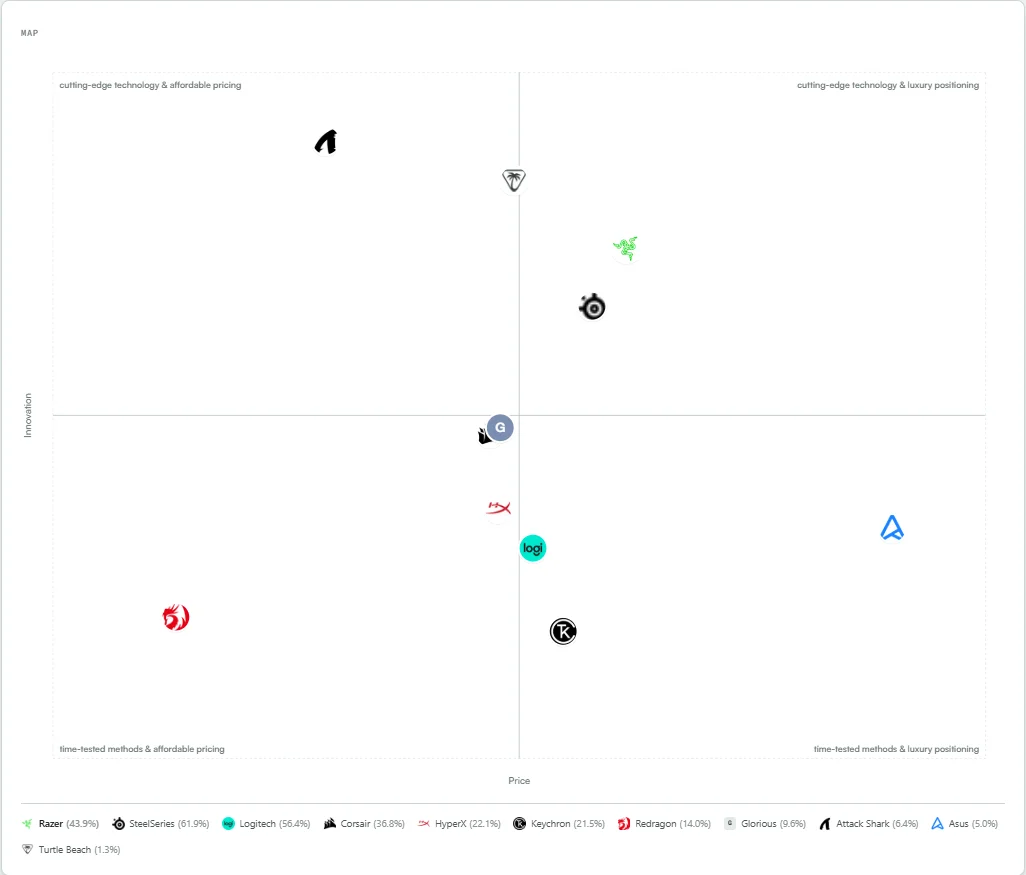
When you can see how AI positions your brand, the right GEO strategy becomes specific and actionable. Different perception gaps call for different interventions. In our analysis of 11 gaming peripheral brands, every low-visibility brand needed a different fix, because each had a different perception problem.
| AI Perception | The Gap | Recommended GEO Action |
|---|---|---|
| High trust, low visibility | Category association too weak | Increase off-site mentions in your specific category contexts |
| High innovation, low trust | Insufficient factual density | Add case studies, statistics, third-party validation to on-site content |
| Perfect sentiment, near-zero SOV | AI "knows" you, does not surface you | Build presence on Reddit, YouTube, review sites, and comparison roundups |
| Wrong category association | Positioned in adjacent market | Reframe on-site content and pursue off-site mentions in the correct category |
| Strong on one platform, invisible on others | Platform-specific citation gap | Target the citation sources preferred by the weaker platforms |
This level of specificity is impossible without perception data. A visibility score tells you the size of the problem. Perception data tells you the shape of it. And the shape determines the strategy.
A study by Wan et al. (ACL 2024, UC Berkeley) found that LLMs favor textual relevance and factual density over stylistic authority signals. Brands with deep factual footprints across the web get recommended. Brands with polished messaging that lacks factual grounding do not. Knowing where your brand falls on that spectrum, and on every other perceptual dimension, is the prerequisite for effective GEO work.
The goal is to build GEO on top of SEO, using the shared foundation while adding the platform-specific and off-site strategies that AI visibility demands. We think about this as a four-layer priority stack. Most SEO programs cover the first layer and part of the second. GEO requires all four, with Layer 3 typically delivering the largest impact.
Engine-specific content optimization, citation source targeting per platform, real chat interface monitoring (not API approximations)
YouTube, Reddit, Wikipedia, review sites, press coverage, expert forums, comparison roundups. Brand mentions (0.664 correlation) outweigh backlinks (0.218) for AI visibility.
Statistics, answer capsules, comparison content, structured data, expert citations. Content freshness on a 90-day cycle (67% citation increase).
Schema markup, page speed, mobile optimization, crawlability, structured headings. Good for Google and good for AI.
Across 748 GEO recommendations we generated for 62 brands, 87% were on-site fixes that brands can implement today. The foundation matters. But the delta between SEO-visible and GEO-visible increasingly lives in Layers 3 and 4, where most SEO programs have no presence at all.
The final difference between SEO and GEO is measurement. SEO has mature tooling: Google Search Console, rank trackers, crawl reports, analytics suites. GEO has none of that infrastructure from the platforms themselves. There is no Search Console for LLMs. AI platforms do not publish impression data, click-through rates, or recommendation logs.
At Sill, we built the measurement layer that GEO requires. We query the actual chat interfaces with web search enabled and citations included, measuring what real buyers see rather than an API approximation. We track AI Share of Voice daily across ChatGPT, Perplexity, Gemini, Google AI Overviews, Copilot, and Grok. And with the Semantic Map, we show how AI models position your brand on any perceptual dimension you define, so you can see the perception gaps that visibility scores alone cannot reveal.
GEO is a new discipline. It builds on SEO's foundation, and it demands its own strategies, its own measurement, and its own understanding of how AI models evaluate the brands they recommend. The overlap with SEO is real and valuable. The gap is where competitive advantage lives.
The brands that recognize this distinction early will compound their advantage over those still treating SEO and GEO as interchangeable.
Map your brand on custom perceptual axes, track AI visibility daily, and get the full picture of how AI models perceive and recommend you across every major platform.
Tell us about your brand and we'll be in touch to walk you through Sill.